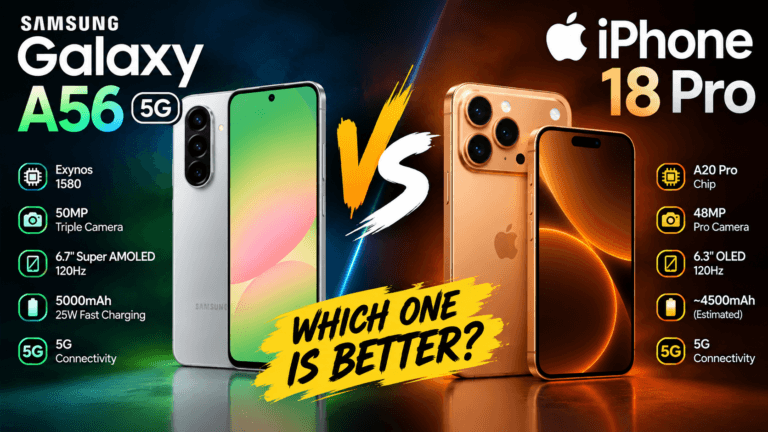
Samsung Galaxy A56 vs iPhone 18 Pro: Which Should You Buy?
A buddy of mine texted me last week: “Should I get the A56 or wait for the new iPhone?” I almost spit out my coffee. Not because it’s a bad question — but because once I actually sat down to do a direct Samsung Galaxy A56 vs iPhone 18 compare test, I realized these two phones aren’t even playing the same sport, let alone the same game.
Here’s the thing nobody tells you upfront: there is no “regular” iPhone 18 yet. Apple split its lineup this year. Only the iPhone 18 Pro and iPhone 18 Pro Max exist right now — they just launched this month. The standard iPhone 18 (the one that would actually compete price-wise with a phone like the A56) isn’t showing up until spring 2027. So when people ask for a Galaxy A56 vs iPhone 18 comparison, what they’re really comparing, whether they realize it or not, is a $499 mid-ranger against a $1,199 flagship.
I’m not going to pretend that’s a fair fight. But I am going to walk you through a complete Samsung Galaxy A56 5G vs iPhone 18 Pro comparison because a lot of readers end up asking Samsung Galaxy A56 vs iPhone 18 Pro which should I buy when deciding between “a good enough phone for less” and “pay double for Apple’s best.” That’s the real decision hiding behind this search: is Samsung Galaxy A56 better than iPhone 18 Pro for your specific daily needs, or should you save up?
I’ve spent real time with the Galaxy A56 5G over the past several months as a daily driver for a family member, and I’ve been going hands-on with the iPhone 18 Pro since launch week. So let me help you decide whether you should buy Samsung Galaxy A56 or iPhone 18 Pro.
Quick Specs Comparison
| Spec | Samsung Galaxy A56 5G | iPhone 18 Pro |
|---|---|---|
| Price (Starting) | $499 (8GB/128GB) | $1,199 (256GB) |
| Display | 6.7″ Super AMOLED, 120Hz, 1900 nits | 6.3″ Super Retina XDR OLED, ProMotion 120Hz |
| Chipset | Exynos 1580 | Apple A20 Pro (2nm) |
| RAM | 8GB (12GB on higher tier) | 12GB |
| Storage Options | 128GB / 256GB | 256GB / 512GB / 1TB / 2TB |
| Rear Cameras | 50MP main, 12MP ultra-wide, 5MP macro | 48MP main (variable aperture), 48MP ultra-wide, 48MP telephoto |
| Front Camera | Under-display style punch hole | 18MP Center Stage |
| Battery & Charging | 5,000mAh, 45W wired charging | ~4,056mAh, 25W MagSafe, reverse wired charging |
| Build | Aluminum frame, Gorilla Glass Victus+, IP67 | Aluminum unibody, Ceramic Shield 2, IP68 |
| OS | Android 15 with One UI 7 | iOS 27 with Apple Intelligence |
| Weight | 198g | 211g |
Samsung Galaxy A56 vs iPhone 18 Compare: The Price Reality Check
I want to get this out of the way before anything else in this Samsung A56 vs iPhone 18 Pro price comparison, because it changes how you should read every section below.
The A56 costs about the same as buying two iPhone 18 Pros’ worth of accessories. That’s not an insult to Samsung’s phone — the A56 is genuinely one of the better mid-range Android phones on the market. It’s just priced for a completely different buyer than the person shopping for a Pro-tier iPhone.
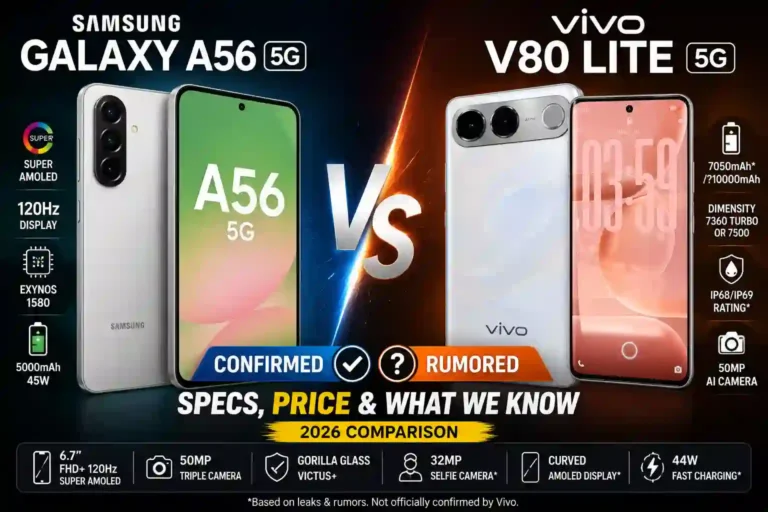
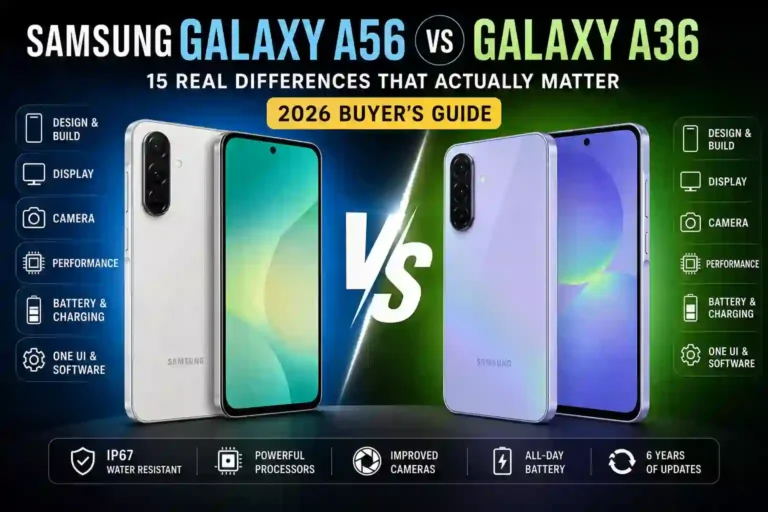
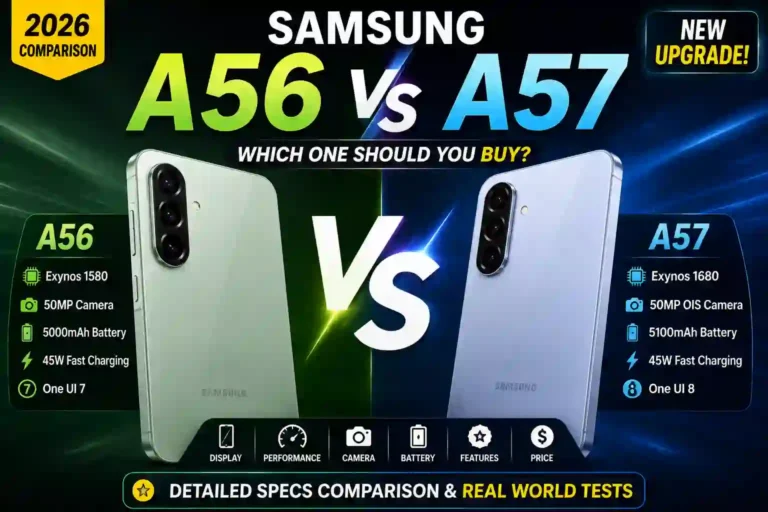
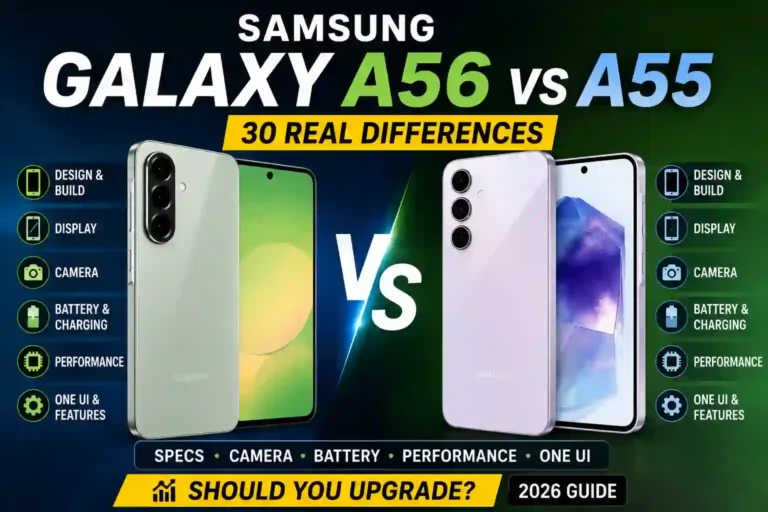
If your budget is actually around $500, you’re not choosing between these two devices. You’re choosing between the A56 and mid-range options like the iPhone 16e or Pixel 9a. (If you want to see how Samsung’s own mid-range family stacks up, check out our Samsung Galaxy A56 vs A55 comparison or our guide on Samsung Galaxy A56 vs A36). The iPhone 18 Pro only enters the conversation if your budget can genuinely stretch to $1,199 or more, or if you’re comparing “what’s the best phone I can get” without a firm budget limit.
I mention this because I’ve seen so many people get talked into stretching their budget to match a review headline, then regret it when the credit card bill shows up. Don’t do that. Decide your budget first, then evaluate this Samsung Galaxy A56 vs iPhone breakdown with that number in mind.
Design and Build Quality
Picking up the Samsung Galaxy A56 5G feels exactly like what it is: a solid, well-made mid-ranger. It’s got a flat aluminum frame, Gorilla Glass Victus+ on the back, and it doesn’t feel cheap or flexy in the hand. It weighs 198 grams and measures about 7.4mm thick, so it’s comfortable for one-handed use if you’ve got average-to-larger hands. It also carries an IP67 rating for water and dust resistance, which covers you for rain, spills, and accidental drops into water. If you do end up buying the A56, securing it with the best Samsung Galaxy A56 back covers and a quality protector from our Galaxy A56 screen protector guide is a smart first move.
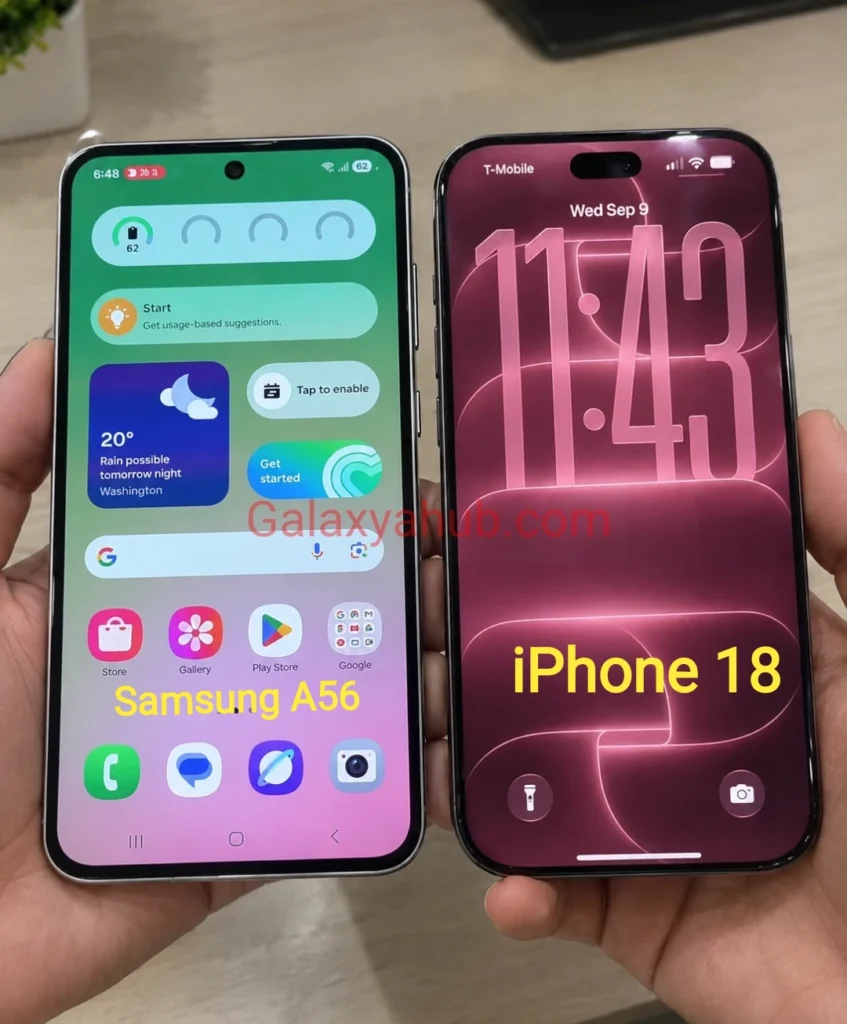
The iPhone 18 Pro feels noticeably more premium the second you hold it — that’s just what an extra $700 buys you. It has a 6.3-inch display, an A20 Pro chipset, and uses Apple’s Ceramic Shield 2 front cover, which Apple claims is tougher against drops and scratches than previous generations. As detailed on Samsung’s official newsroom and Apple’s announcements, structural innovations have redefined durability across both brands. The iPhone’s unibody aluminum frame covers the sides, the camera area, and part of the back, giving it a seamless, one-piece feel compared to the A56’s traditional glass-sandwich design. It also steps up to an anti-reflective coating that helps cut glare in bright sunlight.
Neither phone will fall apart on you. But if build quality and that “expensive object” feel matter most, the Pro wins clearly — as it should at this price.
Galaxy A56 vs iPhone 18 Pro Display Comparison
This is one area where the gap in a Galaxy A56 vs iPhone 18 Pro display comparison is smaller than the price tag suggests.
The A56 features a 6.7-inch Super AMOLED display running at 120Hz with a 2340×1080 resolution and peak brightness around 1,900 nits. In everyday use — scrolling social media, watching YouTube, or texting in bed — it looks genuinely great. Colors pop, blacks are deep, and I never found myself squinting outdoors.
The iPhone 18 Pro’s 6.3-inch Super Retina XDR display uses ProMotion with an adaptive refresh rate up to 120Hz, plus Always-On display and the Dynamic Island. What you’re paying for here isn’t really raw specs — it’s software polish. Apple’s adaptive refresh rate scales more intelligently to save battery, HDR content looks richer, and the Always-On display is handled more elegantly than most Android implementations.
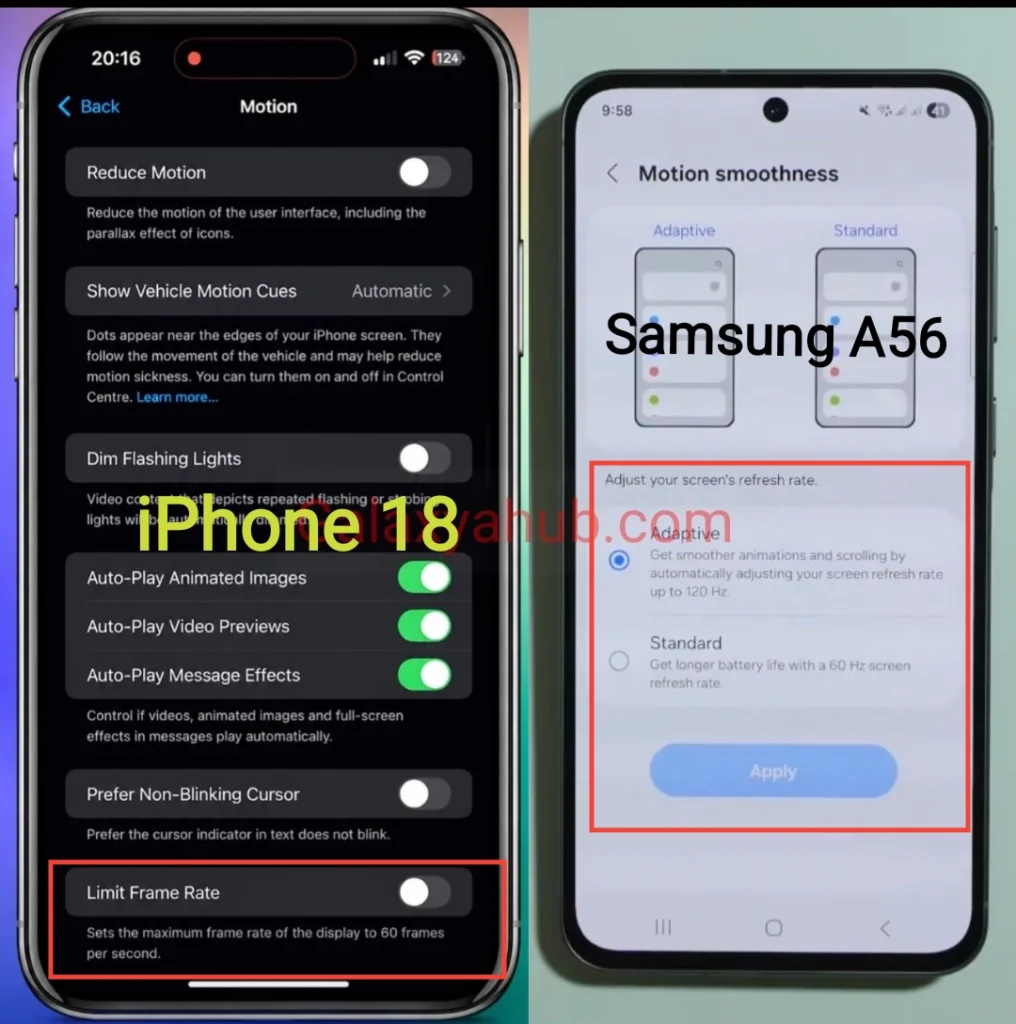
Honestly? If you put both screens side by side showing the same photo, most people wouldn’t pick a clear winner in a blind test. The differences show up more in software optimization and peak brightness handling than in raw visual impact.
Galaxy A56 vs iPhone 18 Pro Performance Comparison
When looking at a Galaxy A56 vs iPhone 18 Pro performance comparison, this is where the price difference stops being subtle.
The A56 runs on Samsung’s Exynos 1580 chip paired with 8GB of LPDDR4 RAM. In benchmark testing on the Geekbench database, it scored around 1,361 on single-core and 3,894 on multi-core. In real life, that translates to smooth everyday performance — opening apps, switching between tasks, casual gaming, and video calls. Where it starts to sweat is running demanding games at maximum graphics settings. If you do notice thermal throttling during long sessions, check out our guide on Galaxy A56 overheating fixes.
The iPhone 18 Pro operates in a completely different galaxy of performance. Its A20 Pro chip is built on Apple’s newest 2nm process, featuring a 6-core CPU, 7-core GPU with Neural Accelerators, and 12GB of RAM. Benchmark testing places it at roughly 4,719 single-core and 12,677 multi-core on Geekbench 6. That is a massive hardware gap. Apple also redesigned the internal thermal system with a new vapor chamber for sustained output.
In evaluating Galaxy A56 vs iPhone 18 Pro for gaming or heavy computing, the A56 is plenty fast for everyday tasks, but the iPhone 18 Pro offers far higher performance headroom.
Galaxy A56 vs iPhone 18 Pro Camera Comparison
In any Galaxy A56 vs iPhone 18 Pro camera comparison, the hardware separation becomes obvious immediately.
The A56’s camera setup features a 50-megapixel main wide camera, a 12-megapixel ultra-wide, and a 5-megapixel macro lens. In good daylight, photos come out sharp with punchy colors. Low light is where it stumbles slightly, showing more noise and softer detail. Because there is no dedicated optical telephoto lens, zoomed shots rely on digital cropping. To get the best out of this setup, check out our guides on how to improve Samsung Galaxy A56 camera quality, tweaking the right Samsung Galaxy A56 camera settings, and using our Samsung Galaxy A56 night mode tips.
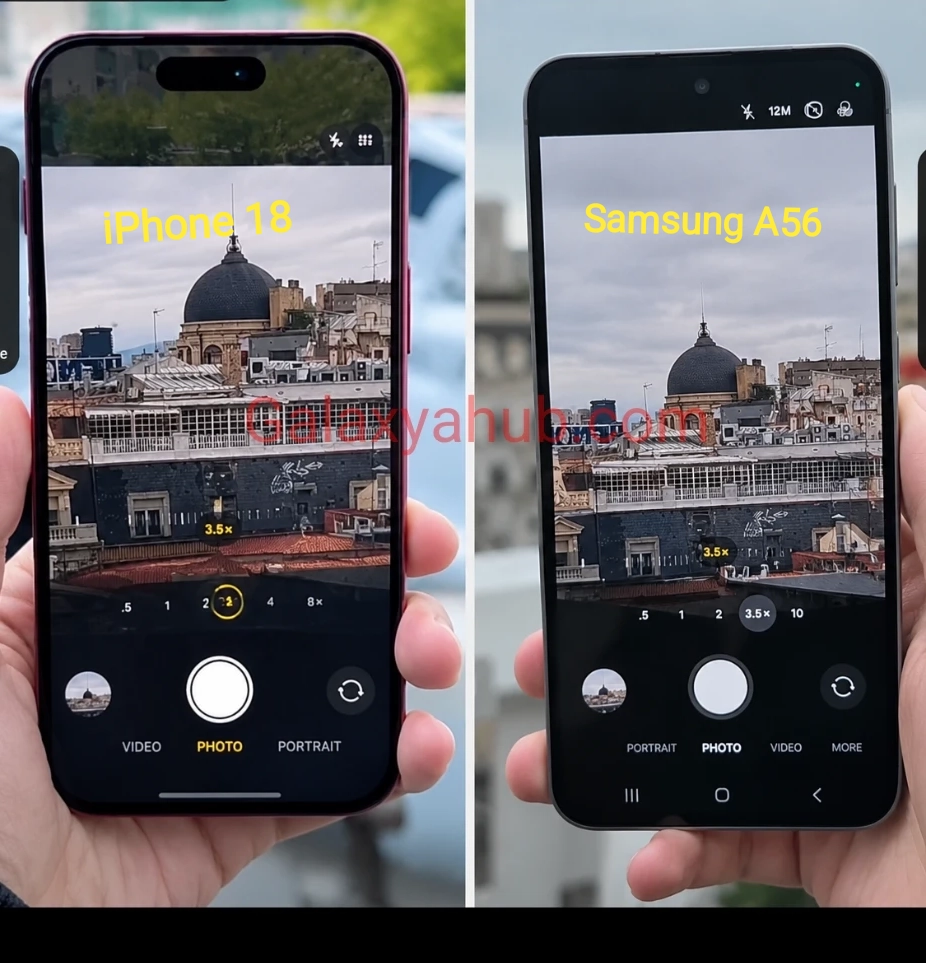
The iPhone 18 Pro’s camera system is a major step up in both hardware and versatility. It uses a 48MP Fusion main camera with a variable aperture that shifts between f/1.48 and f/4.0 using six laser-cut blades, alongside a 48MP Fusion Ultra Wide and a 48MP Fusion Telephoto lens offering optical zoom from 0.5x to 8x. The variable aperture provides physical control over depth of field, and the Camera app now includes manual controls for aperture and shutter speed.
When evaluating Galaxy A56 vs iPhone 18 Pro for photography, the iPhone 18 Pro is clearly superior for telephoto clarity, low-light consistency, and cinematic video. However, for casual daylight snapshots posted to social media, the Samsung Galaxy A56 vs iPhone 18 Pro camera performance on the A56 remains very respectable for its price point.
Galaxy A56 vs iPhone 18 Pro Battery & Charging Comparison
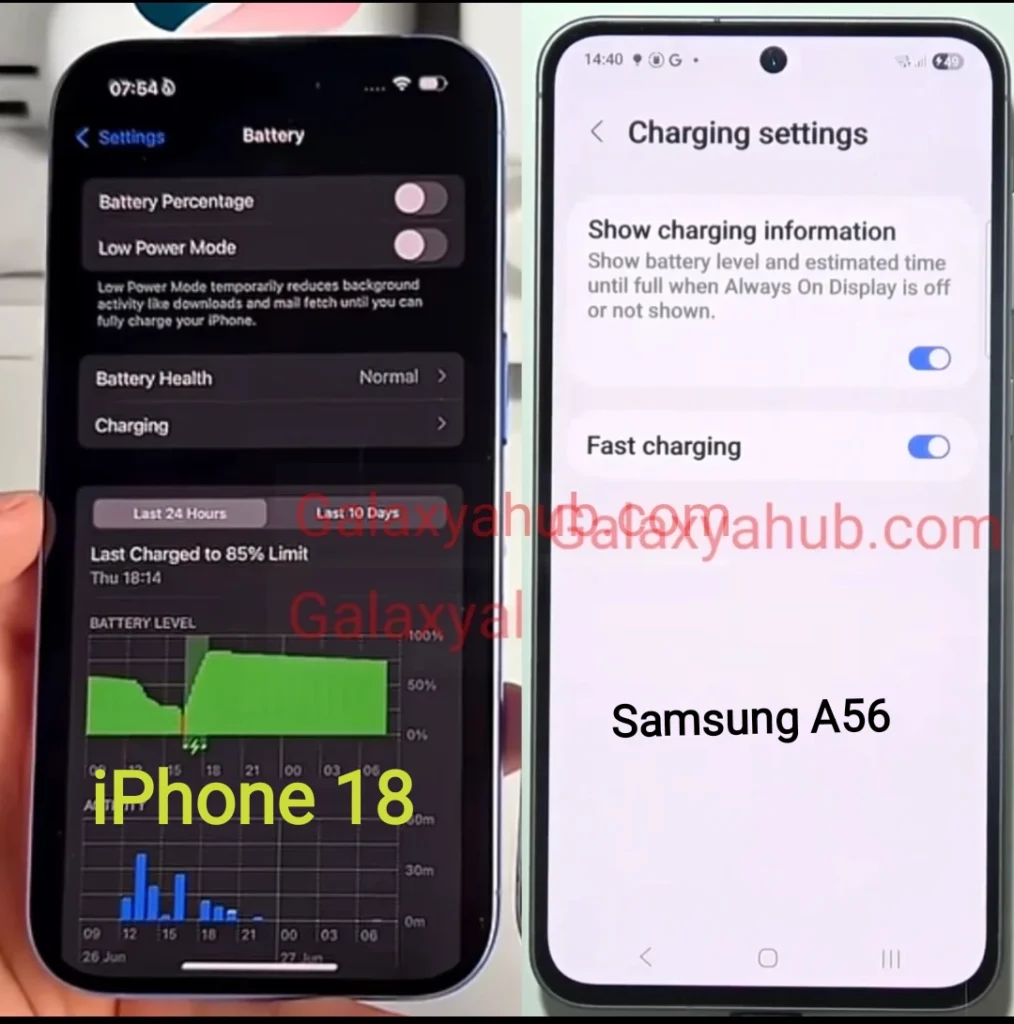
In this Galaxy A56 vs iPhone 18 Pro battery comparison, both devices offer strong endurance, but they handle charging differently.
The A56 packs a 5,000mAh battery with support for 45W wired charging. Moderate use (social media, messaging, video streaming, and casual gaming) comfortably lasts a full day, sometimes stretching into a second day. If you want to maximize your runtime, read our tips on how to improve Samsung Galaxy A56 battery life.
The iPhone 18 Pro houses a smaller physical battery capacity (~4,056mAh), but Apple’s silicon efficiency allows it to achieve up to 36 hours of continuous video playback. Wireless charging tops out at 25W via MagSafe, and it supports reverse wired charging for accessories.
In a Galaxy A56 vs iPhone 18 Pro charging comparison, the A56’s 45W wired charging provides faster top-ups from 0% when using a compatible charger. If you run into any issues getting full speed, consult our Samsung Galaxy A56 fast charging fix guide.
Galaxy A56 vs iPhone 18 Pro Software Comparison & Long Term Use
A thorough Galaxy A56 vs iPhone 18 Pro software comparison comes down to your operating system preference.
The A56 ships with Android 15 running Samsung’s One UI 7. Samsung’s interface is fantastic for customization, split-screen multitasking, and productivity shortcuts. You can explore our guides to the best One UI settings for Samsung A56 and our list of Samsung Galaxy A56 tips and tricks to unlock its full potential. You can also review general platform features on the official Android site.
The iPhone 18 Pro runs iOS 27, which incorporates deeply integrated Apple Intelligence tools and an updated Siri experience. Learn more about the ecosystem on the official Apple website.
When evaluating Galaxy A56 vs iPhone 18 Pro long term use, Apple continues to lead the industry in multi-year OS update consistency, though Samsung has expanded support for its A-series phones significantly compared to previous generations.
Step-by-Step: How to Actually Decide Between Them
- Set your real budget first. Decide on the exact number you’re comfortable spending today without taking on unnecessary stress.
- Evaluate the price floor. If you want to spend under $600, the A56 is your realistic option here; the iPhone 18 Pro isn’t in play at that price point.
- Determine flagship necessity. If you have $1,200+, decide if you truly need professional video features and 8x optical zoom, or if you’d rather save $700.
- Check your existing devices. If you already use a Mac, iPad, or Apple Watch, the iPhone integrates seamlessly. If you rely on Windows, PC setups, or Google services, Android is often more flexible.
- Factor in your upgrade cycle. If you upgrade every 2 to 3 years, the A56 provides incredible financial value. If you hold onto phones for 5+ years, the iPhone 18 Pro’s long-term hardware headroom pays off.
- Prioritize camera requirements. If you record high-end video or shoot in low light constantly, choose the iPhone. For everyday casual photography, the A56 performs admirably.
Common Mistakes People Make
- Comparing specs strictly on paper. Hardware numbers don’t tell the full story regarding real-world camera processing, real-time software responsiveness, or long-term system optimization.
- Assuming “iPhone 18” means the budget model. The standard base iPhone 18 isn’t released yet; only Pro models are currently on the market.
- Overstretching your budget. Buying a flagship phone that causes financial strain is never worth the minor tech upgrade.
- Ignoring storage limits. The A56 tops out at 256GB without microSD expansion — if you shoot high-bitrate video, account for your storage needs early.
- Overlooking trade-in value. Always check active carrier or trade-in promotions before making a final decision.
Practical Tips From Using Both
- On the A56, check out our guide on the first things to do on Samsung Galaxy A56 to configure your device properly right out of the box.
- Turn off “Motion smoothness: Adaptive” in display settings on the A56 if you notice occasional stutter — locking it to standard 120Hz can feel smoother in daily use.
- Use the A56’s 5MP macro lens for detailed close-ups of textures, small objects, or nature photography.
- On the iPhone 18 Pro, spend ten minutes testing the manual exposure and variable aperture sliders in the camera app before taking important photos.
- Equip whichever phone you buy with a durable case and glass screen protector on day one.
Pros and Cons
Samsung Galaxy A56 5G
Pros:
- Exceptional value at $499
- Bright, smooth 6.7-inch 120Hz AMOLED display
- Dependable battery life with fast 45W wired charging
- IP67 water and dust resistance
- Sharp 50MP main camera in good lighting
Cons:
- Exynos 1580 chip slows down under sustained heavy 3D gaming
- Lacks a dedicated telephoto zoom lens
- 8GB RAM base configuration
- No wireless charging support
iPhone 18 Pro
Pros:
- Unrivaled A20 Pro chipset performance
- Highly versatile triple 48MP camera system with physical variable aperture
- Premium unibody design with Ceramic Shield 2 and IP68 rating
- Long-term iOS software support window
- Excellent thermal management via redesigned cooling
Cons:
- High starting price ($1,199)
- No wall charger included in the box
- Overkill performance for users who only browse, text, and stream
- Higher storage tiers become expensive quickly
FAQs
Is the standard iPhone 18 out yet?
No. Currently, only the iPhone 18 Pro and iPhone 18 Pro Max are available. The standard base iPhone 18 is expected in spring 2027.
Is the Galaxy A56 5G a good phone for the price?
Yes. At $499, it delivers a high-quality 120Hz AMOLED panel, solid daylight camera performance, reliable battery life, and IP67 water resistance.
Which phone has a better camera?
The iPhone 18 Pro. It features a true 48MP telephoto lens with 8x optical range, variable mechanical aperture, and far stronger low-light and video capabilities.
Will the A56 handle heavy gaming well?
It handles casual and mid-tier games easily. However, for demanding 3D games running at maximum graphic settings, you will experience frame drops compared to flagship devices.
How long will each phone get software updates?
Apple routinely supports iPhones for 5+ years of major iOS upgrades. Samsung provides several years of major Android updates for the A-series, though Apple generally maintains support longer.
Should I wait for the standard iPhone 18 instead of buying the A56 now?
If you are deeply tied to the Apple ecosystem and can wait until spring 2027, holding off may make sense. If you need a reliable smartphone today at a moderate price, the A56 is available right now.
Does the Galaxy A56 support wireless charging?
No, the Galaxy A56 does not support wireless charging. It charges exclusively via USB-C at up to 45W.
Is the price gap between these two phones actually justified?
Partly. You are paying for top-tier processing power, professional camera hardware, and premium materials on the iPhone 18 Pro. However, if your daily phone use consists primarily of web browsing, social media, messaging, and video streaming, the A56 delivers most of what you need for less than half the price.